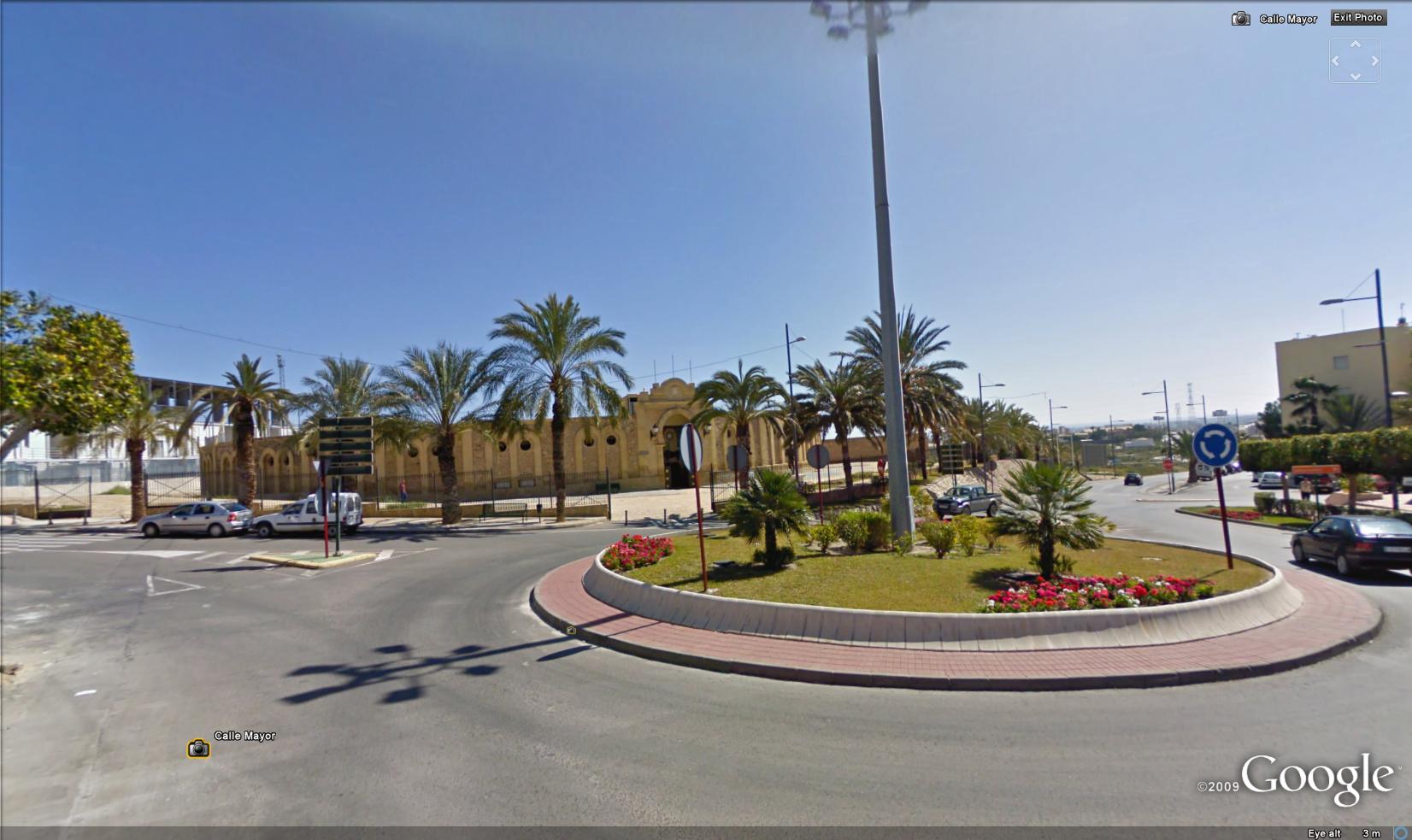
David Locke—a man who never lived—died at this spot in the Hotel de La Gloria which was never real and has vanished.
If Antonioni played fast and loose with the geography--the reality--of the Eur, Fellini did so as well in La dolce vita: The exterior shots of Steiner’s apartment were filmed at Piazza San Giovanni Borgo, an area within approximately 500 meters of Cinecittà. The interior of Steiner’s apartment was a set in Cinecittà with a “false” view of the Eur (the Eur being some 8 km southwest of Cinecittà) seen through the windows of Steiner’s apartment, analogous to the false view of the Fungo and the Eur seen from a window of Riccardo’s apartment in L’eclisse (see <http://www.initaly.com/regions/latium/romemoviealb.htm> retrieved 21 November, 2007).
Crossing Via Tuscolana, on the opposite side of the Quadraro, on nearby piazza San Giovanni Bosco, Federico Fellini directed some scenes of La dolce vita. Professor Steiner (Alain Cuny), a friend of Marcello, lives on this square. The film starts with a long sequence of the Christ statue flown by a helicopter over the metal cupola of the San Giovanni Bosco church and on, over all of Roma. But the scene to remember is the one in which Steiner’s wife is informed of her husband’s suicide, all the paparazzi rush to interview her on the square and Mastroianni, trying to protect her, gets her into a car and defends her from the photographers. Strangely, Fellini filmed the square in all exteriors of Steiner’s apartment, while he used the Palaeur [Eur] as background in the reconstructed interiors in Cinecittà, making believe to be in EUR.
(Rome, the Great Movie Set, pages 38-41, published in both English and Italian editions by the Azienda di Promozione Turistica di Roma. Available on-line as of 3 October, 2008 at: http://www.romaturismo.it/v2/richiestamateriali/pdf/cinema_en.pdf ).
There is nothing particularly strange about Fellini’s “unrealistic” slicing and dicing of Rome. In movies, nothing is real except for the illusion of reality. Many movies are made entirely on a set; in the future an increasing percentage of movies will be made in a small box called a computer. William Wyler’s gem of a 1936 movie, Dodsworth, is set in multiple locales ranging from the American Midwest to Italy; the film, however, was made almost entirely on the back lot of the Goldwyn studios, the Bay of Naples included. The 2010 film, When in Rome, might have been more appropriately titled “When in Rome and New York City” insofar as the scenes that are represented as taking place in Rome were actually shot in both Rome and New York. (To my knowledge, none of the “New York” scenes were shot in Rome. Contrariwise, Scorsese’s Gangs of New York [2002] was shot at Cinecittà in Rome.) There is less of a distinction between an animated film like Fantasia and live action movies such as Dodsworth or La dolce vita than meets the eye (the vision becoming evermore blurred in movies such as Who Framed Roger Rabbit?).
For Fellini it was presumably more convenient to shoot exteriors of the Steiner apartment at Piazza San Giovanni Bosco close to Cinecittà and to “fake” the interior scenes of the apartment as if they were in the Eur. The average non-Italian wouldn’t know the difference, and even if the Italian viewer perceived the geographic incongruity, such a viewer might not care. Fellini simply took advantage of the cinema’s “privilege of ubiquity.” Antonioni may have done something particularly puzzling in The Passenger in this regard. In a personal communication in 2009 from Belen Gavela of Madrid, Profa. Gavela raised to me the probability that the Hotel de la Gloria (itself a fabrication constructed for the film) was not actually located in the Spanish town of Osuna—as portrayed in The Passenger—but in the vicinity of Spain’s “Hollywood,” the province of Almería, where the majority of Italy´s spaghetti westerns were shot and where technical facilities were at hand. (John Orr has made a similar claim but offers no documentation. See the Internet site: Filmint. [Issue 27], “Camus and Carné Transformed: Bergman’s ‘The Silence’ vs. Antonioni’s ‘The Passenger’ ”; http://www.filmint.nu/?q=node/83 [retrieved 26 June 2009].) Indeed, the filming site of the finale of The Passenger was in Almería at the Plaza de Toros near the present day “glorieta” (“roundabout,” an ironic resonance in Spanish with the Hotel de la Gloria, i.e., At or very near the Hotel de la Gloria of the film, The Passenger, is now a glorieta.) at the junction of Calle Mayor and Calle del Mojigato in the town of Vera near the Mediterranean Sea, approximately 35 km NE from the hilltop town of Sorbas near where the pan of David Locke’s car--like the barrel in L'eclisse--was punctured. (For a brief video clip of the bullring, located in the 1970’s on the southeastern outskirts of Vera, renovated in 1993, and what the site presently looks like see: <http://www.youtube.com/watch?v=nm6sJVyyvgw> [accessed 22 April 2010]. One may also “tour” the site from a computer desktop anywhere on the planet employing “Google Earth.” Please note that the word “vera” is the feminine declension of the Italian adjective, “vero,” meaning “true.” In Italian “vera” is also a feminine noun meaning “wedding ring,” a synonym for another Italian word, “fede,” which also signifies “wedding ring” as well as “faith.” In Spanish, “verá” is the third person singular, future simple conjugated form of the verb, “ver,” meaning “he [she] will see”; this is a tragic play on words in the light of David Locke’s plight while lying on his deathbed at the end of The Passenger concerning the issue of blindness—which Locke discusses with the Girl—and Locke’s own inability [choice?] to see outside his hotel window prior to his imminent death. [Locke will “see” the plaza only after he has died and Antonioni’s camera seems to magically glide through the window’s bars.] Lastly, like other names in Robertson’s black book, “Vera” is a female given name [as well as a Spanish surname].)
David Locke—a man who never lived—died at this spot in the Hotel de La Gloria which was never real and has vanished.
The critical distinction between Fellini and Antonioni with regard to the specific circumstance of La dolce vita and L'eclisse respectively, is that Antonioni presumably did not create the “geographic incongruity” of the scene with Piero in the Eur with its “impossible” building in the background for the sake of convenience. I suspect that, instead, Antonioni manufactured and reassembled the reality of this latter scene in the Eur as a highly sophisticated visual play on both words and images. Although Antonioni’s movies are generally “realistic,” he will occasionally violate reality for an artistic, aesthetic, or thematic goal. (A small example would be how Antonioni seems not to care whether it is feasible for Vittoria—out of the clear blue—to adopt in Marta’s apartment an elaborate costume with makeup and masquerade as an African woman; in reality it no doubt required many hours to design the costume, manufacture it, and with the help of professional makeup artists both apply makeup and costume the actress, Monica Vitti, and then remove makeup and costume.) Antonioni stands opposed, however, to the orientation of much of the entire history of American cinema: to substitute reality with illusion that panders to falsity as opposed to truth.